

Should I Dispute A Copyright Claim On Youtube
YouTubers, do you lot know the difference betwixt a copyright merits and a copyright strike? If not, find out right now.
The world of copyright isn't always equally cut and dried as a rights holder claiming that you used their content. There can be a number of complicated moving parts when information technology comes to digital rights direction and your responsibilities and obligations as a YouTube creator.
In the starting time of a series on rights management and social video, we're going to answer a question nosotros go asked a lot: what is the difference between a copyright strike and a copyright merits?
Obligatory disclaimer: Delight note that this post is an overview of how copyright works on YouTube. Please consult a lawyer if you lot need communication on a specific example.
Before we take a deeper dive into the differences, hither's a quick overview of both types of copyright infringement processes. Essentially a copyright merits is someone asserting that you have used their content, whether that be a video clip, an prototype, or a slice of audio. A copyright strike is much more serious for a YouTube creator and your channel can be suspended for repeated copyright offenses.
1 Infinitesimal Guide: Copyright Claims
Copyright claims are too known as Content ID claims. Content ID is a fully-automated digital rights direction tool on the YouTube platform that scans videos and notifies the rights holder if their video clips, images, or sound have been used without express permission. Regarding copyright/Content ID claims yous should know the following:
- A claim volition not adversely affect your YouTube channel.
- The rights holder can merits the revenue on your video if yous have used their content.
- The copyright holder can identify ads on your video to generate that acquirement.
- The copyright holder tin restrict your video in some countries or regions.
- The copyright holder may as well choose to take no action (only absolutely don't rely on that!)
- Copyright claims are a part of Copyright Law.
- Copyright claims only apply to the videos flagged and non the unabridged channel
- A claim can be proven false depending upon if yous really own the content that is being claimed by someone else.
i Infinitesimal Guide: Copyright Strikes

A copyright strike is issued to a creator if they've uploaded something within their video that they do not ain the rights to. The copyright holder has the correct to remove that video from YouTube altogether, which ways it'south blocked everywhere and the ability to generate any further ad revenue is shut down. Creators should know the following about copyright strikes on YouTube:
- A copyright strike WILL adversely impact your channel.
- The copyright holder can completely remove your video from YouTube.
- If you receive a copyright strike yous won't exist able to monetize your videos.
- Y'all also won't be able to live stream from your account.
- If yous receive iii copyright strikes, your YouTube channel will exist terminated and you'll exist banned from creating another one.
- Copyright strikes expire later three months.
YouTube's Current Copyright Policy
Unsurprisingly, YouTube isn't here to play when it comes to copyright infringement. The platform has solid guidelines that match copyright policies in the U.s.a. (and presumably beyond), and it states very clearly that:
"Creators should only upload videos that they have fabricated or that they're authorized to utilize. Users should not upload videos that they didn't make or utilize content in videos that someone else owns without necessary authorizations."
So, with that alert in mind, let'due south take a more detailed look at claims and strikes.
Copyright Claims AKA Content ID Claims
YouTube's copyright infringement detection is incredibly sophisticated. The platform uses proprietary software called Content ID which scans content and notifies creators (who have admission to the tool) where their work may accept been copied. That creator can then decide whether to make a claim, depending on whether the video falls under Fair Use, instead of submitting a copyright takedown find.
These YouTube accounts tin likewise make a transmission merits for annihilation the Content ID tool misses for any reason.
Every bit a general rule, Content ID claims are made against video clips, sound, and other content that qualifies as endemic media and hasn't been available for publication on YouTube. Claims are issued to creators if they don't ain the Television set or music clips, music, or other copyrighted media.
The rights owners take full control of their Content ID policy. Some creators and media publishers e'er opt to stop certain content from being uploaded to YouTube, like TV clips or music videos. Others allow their content to remain published on the uploader's channel merely only if some or all of the advertising revenue is funneled back to the copyright owners as compensation.
That all sounds a picayune confusing so let's pause it down.
ContentID claims come with a monetization, tracking, or viewing restriction rule. For the latter, the video may only remain alive in certain countries or regions at the rightsholder's discretion. The owner can as well decide to:
- Block the entire video from being viewed on YouTube.
- Monetize the video by placing ads against it - this might come up with the pick of a potential revenue share with the uploader.
- The rights owner takes 100% of the acquirement share from ads. The creator can still keep the video up but they won't generate whatever revenue from that upload.
- Rails the video's viewership stats which disables whatsoever monetization and lets the possessor see how well your video is performing in case they cull to claim whatsoever revenue in the future.
YouTube itself has a handy guide for the options here:
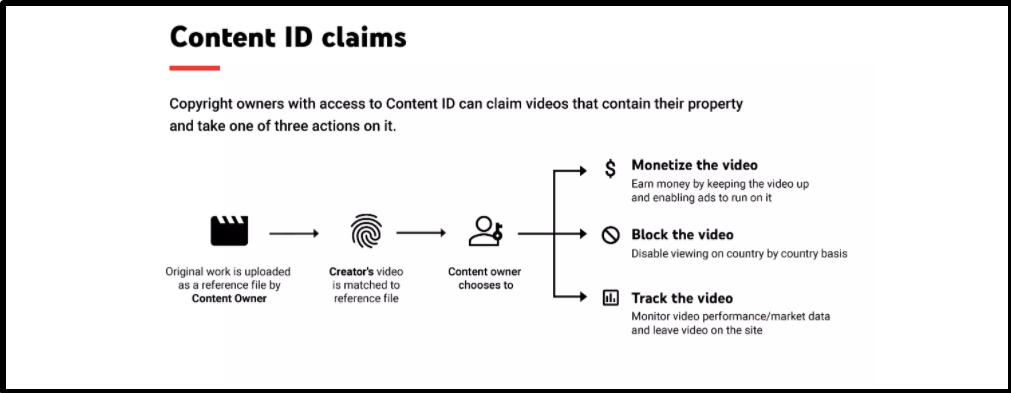
Note: Not anybody can access the Content ID characteristic. YouTube has very specific criteria for rights owners who want to track their content. Find out more details here.
OK, let's tackle what happens if you receive a Content ID claim against one of your videos.
In order to resolve and remove a copyright claim, the uploader volition need to dispute it. Once the claim has been formally disputed by the uploader, the rights owner then has 30 days to respond to that appeal with the pick of either:
- Releasing the claim if they observe evidence that the uploader does in fact have permission to use the cloth (every bit is oft the case when a creator uses a music track licensed through a third party like Epidemic Sound).
- Rejecting the dispute and upholding the claim because they believe they nevertheless have a potent and valid case
- Removing the video in question from YouTube past submitting a copyright takedown request. This will lead to a copyright strike against your channel (run into beneath).
- Deciding non to reply to the appeal and let the claim on their part expire.
While the content is in dispute any viewing restrictions are reversed, and the video tin can continue to generate acquirement through ads. However, that acquirement will exist held in a neutral account and simply released to the party who wins the dispute.
If the rights owner doesn't respond within 30 days, the Content ID claim is automatically released. But if they reject the dispute, the claim gets reinstated again. The uploader can once more appeal and fight their case, and again, the rights holder has thirty days to reply. In the meantime, the advertizing revenue holding account kicks in again, as does the lift on whatever viewing restrictions.
At this stage in the dispute, the rights possessor can either release their merits, choose to take downwardly the video, or set upwards a "delayed takedown." If the possessor opts to go down the delayed takedown road, the uploader will be automatically notified that they have just 7 days to retract their appeal or the video will be automatically taken down and disappear forever from YouTube.
Talking of YouTube, take a few minutes to scout their advice about ContentID claims:
Copyright Strikes and Takedowns
Then, we've covered the master points of Content ID claims, now let's take a look at copyright strikes.
PSA: You do NOT want to concenter any copyright strikes confronting your channel!
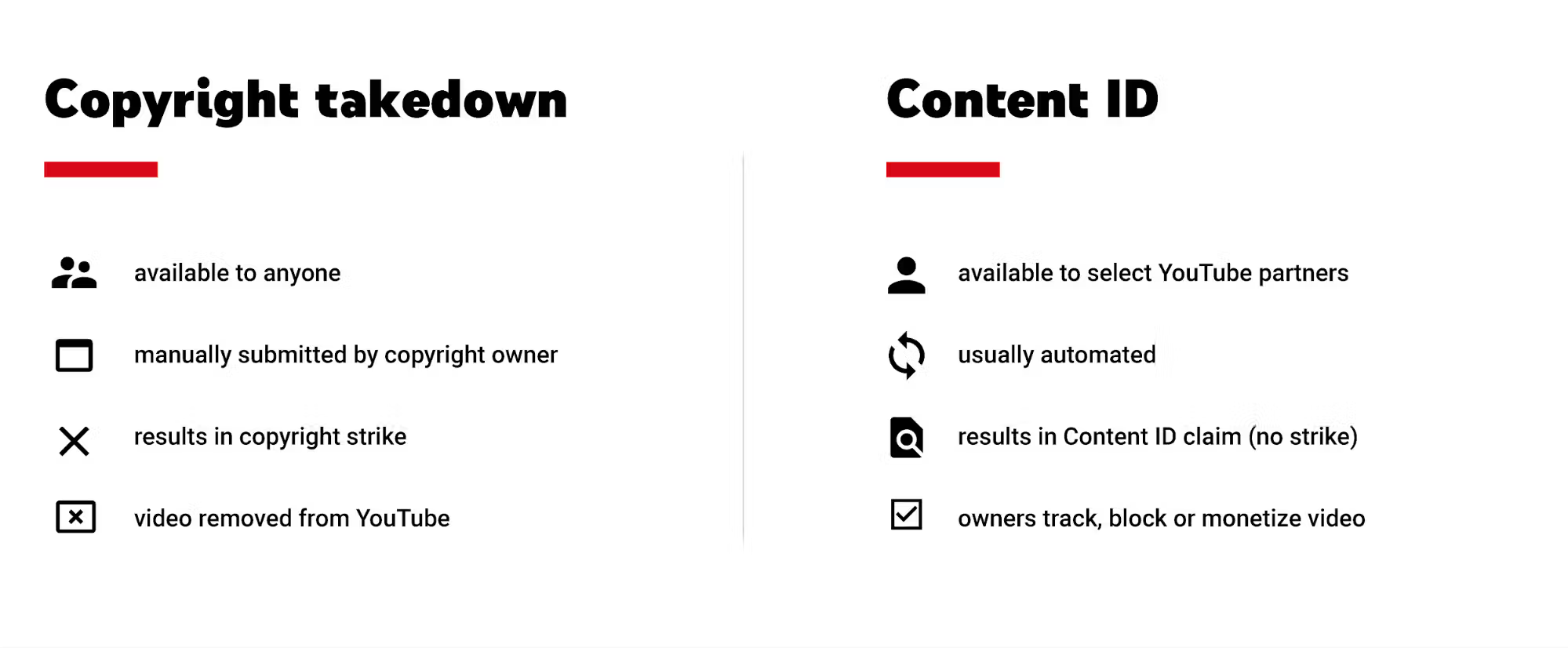
A copyright strike is issued when a rights owner requests the legal removal of a video on YouTube because the uploader didn't accept the permission to use their images, audio, or video clips. As you lot can run across from the image to a higher place (thanks YouTube), a strike differs significantly from a claim.
Copyright strikes are manual and are activated when a rights owner files a DMCA takedown request. The owner must supply YouTube with specific information regarding the takedown which includes:
- The rightsholder'southward contact information.
- A thorough description of the cloth the possessor wants to protect.
- A sworn statement of good religion belief that the material (a video clip, a gif, an image, etc) has been used without express permission.
After a takedown asking is filed by the rights owner, YouTube has to remove the video in question from the uploader's channel. That creator is notified, and they can either file a counter-notice or have the takedown decision.
If the video is taken down following a manual claim, the creator'southward aqueduct volition receive a copyright strike. Oh, and deleting the offending video will non resolve the strike.
What Happens Later on Your First Copyright Strike?
If you receive a copyright strike against a video, take that every bit a real warning that YouTube at present believes that your account is losing skillful standing. The first copyright strike received may negatively affect some channel features like a finish to any live streaming or monetization.
YouTube is willing to requite the creator some other chance at this stage though because the beginning copyright strike will elapse after 90 days as long as they consummate the courses in YouTube's Copyright School (yes, that'due south a real thing).
What Happens After Your 2nd and Third Copyright Strike?
OK, the danger level simply turned up a notch. If your channels receive a second copyright strike before the first strike has even expired, you will take then have to wait another xc days until the second strike has expired. In the meantime, your business relationship remains out of skilful standing.
If you receive a third copyright strike before the kickoff two strikes accept expired, YouTube will automatically finish your business relationship and remove all of your uploaded videos. Y'all'll also be banned from creating any new channels.
In a few cases, the bad news doesn't end there. Y'all could face a legal challenge and the media you lot used without permission could take you all the mode to court. If yous lose the instance yous could end up with massive legal fees plus a substantial fine to pay off. Proficient times.
Can You Still Monetize Your YouTube Channel If You Take Received a Copyright Claim or Copyright Strike?
Nosotros've covered this topic in the video below. and the respond is perchance, maybe, but also probably not.
If you apply for the YouTube Partner Program but aren't accepted, YouTube doesn't give enough of an caption equally to why y'all were rejected, then you'll never know whether your application failed because of a copyright event.
However, we do know that to monetize your channel, y'all have to comply with YouTube's Terms of Service, copyright guidelines, and community guidelines, every bit well equally Google'southward ad policies.
So if you take a copyright claim or a copyright strike on your aqueduct, will you be rejected for monetization? No, only acquit in mind copyright strikes are serious offenses.
If your channel has no copyright claims, and no copyright strikes, y'all'll automatically be accepted into the YouTube Partner Program? Again, no because y'all've also got to consider all of the other customs guidelines you need to adhere to.
Further Resources: Copyright and YouTube
★ What is copyright?
★ What is a Content ID claim?
★ Copyright strike basics
★ The difference between copyright takedowns and Content ID claims
★ The legal issues all YouTube creators need to know about
★ The expert'due south guide to Fair Utilise & copyright on YouTube
★ How to get royalty-gratis music for your YouTube videos
★ Copyright and rights direction
★ Often asked copyright questions

Carla Marshall has 10+ years of experience in video marketing, social media direction, content marketing, DRM, and SEO. She was previously Editor in Primary at ReelSEO.com, and as a journalist and video marketer, she's covered news stories, creator journeys, and digital-first publishing initiatives across all the major online video platforms. She is YouTube Certified and a judge for the Shorty Awards, equally well as the U.k., US, Canadian, Global, and EU Search Awards.
Source: https://vidiq.com/blog/post/youtube-copyright-claim-copyright-strike/
Posted by: conefingir.blogspot.com
0 Response to "Should I Dispute A Copyright Claim On Youtube"
Post a Comment